Team Lead – here is what your boss isn’t telling you, yet still expects of you

oops

(discuss on Hacker News)

I believe that many team leaders feel constantly under fire because nobody tells them the entire story. They are too busy loading the ship with goods and pushing it forward, without thinking about their crew, their ship, or for that manner, the big blue ocean and the dangers in sailing to the unknown.

 Let me start with what your boss does tell you:

  1. You need to deliver results.
  2. You need to deliver on time.
  3. You need to communicate – raise flags, synchronize effort with other teams etc.

So you’re leaving your one-on-one meetings with your boss “checking” every one of the bullets above, yet, you feel as if you’re missing something. You’re exhausted.

It gets even worse.

If things are going well (for the company that is,) you are suddenly asked to hire more people. “Awesome, right?” your boss says; “Hell no!” you reply, “I’ve got so much on my plate. I don’t know how I could manage more people without completely losing it!”

It feels strange. You deliver great results on time, you are communicative and you love your teammates, so why do you feel out of control? Why cannot you relax?

There is an underlying expectation that nobody told you about - as a team lead, it is your job to enable your company’s scalability. [Tweet it!]

“Scalable Company” can align and adjust its team and goals without losing its unique culture (vision, values and people) in the process.

It means changing direction if the business doesn’t make sense anymore, without feeling resentment: “but I’ve invested so much time in it!” It means growing from a team of 15 to 50 without feeling pinned down: “oh gosh, it used to be fun working here. Now I need to write a 50-page document just to get something to move forward.”

Just like a scalable architecture – you can bring more users, enhance your product and the experience remains smooth. Many things happen under the hood to support it, but the end result remains the same.

Adjusting to a new reality means it will be different, but not necessarily “bad different.” It should feel as if you were already thinking about it and prepared a few plans to make it into a smooth(er) transition. There is nothing worse to a company than an ad-hoc growth without strategic planning in advance. It will only cause more panic.

Because most of us are not aware of this hidden expectation, we continue to work hard on our deliveries, but constantly fail when the company needs to adjust. “There was never enough time to prepare for it!” you surrender, mumbling “Nobody told me we need to change everything” as you exit the door. It’s too late by now.

It shouldn’t have to be this way.

In order to enable scalable companies, team leads have to proactively prepare for it:

1. Clear the way

That means detecting blockers and think of ways to remove them. Notice I didn’t say to actually remove it on your own necessarily. It’s based on the maturity of the team. It’s your job however, to monitor your team’s velocity, spot major issues and follow up on them.

2. Work on things that move the needle

Are you working on the right things? Do you help your company succeed? Do you believe in the direction your company is taking? Do you provide constructive feedback to your boss and colleagues? You better! Your teammates will feel it if you don’t. You can “hide” it for a few months, and justify dumb business decisions you do not agree with. Maybe you feel these decisions are dumb just because you didn’t have time to ask more questions? Eventually, your team expects you to push them, and if you don’t believe in your own words, people will stop trusting you.

3. Teach others how to ask critical questions

You can’t be everywhere. Assume two of your teammates are working closely with another team. Do you trust them to ask the right questions? For example: should we be ready for scale on day 1 or can we create a simple solution and monitor usage? Do we know how to test it? Do we know how to deploy it? What can go wrong? What will we do if it does go wrong? Do we know how to monitor it? What is our success metric for this feature? Can we break it into small milestones and reduce risk? Can we deliver value earlier?

 4. Make your people happy

Here is why – you are responsible for your team’s happiness because losing your people will slow you down to a point where the culture might be damaged.  And yes, you should make them happy for all of the other reasons you heard before. The alternative, if it wasn’t clear so far, can kill your company’s culture. It would be hard to recover from that.

5. Delegate as much as possible

Not only to free a couple of hours for “work time,” but also to distribute pressure and responsibilities. It shouldn’t be only up to you to handle everything. That means you will also need to let them fail. Yes I know, you think you can do it better than them, but can you teach them or is it a God’s gift? You need to give them time and encourage them when they are putting the effort.

6. Always have a plan for growth

You have to pretend as if your team is now two times bigger. Work backwards. Will the team continue to execute, or will it get stuck because you failed to scale yourself? Do you have team lead candidates that you started to mentor? Do you know how to mentor other team leads? Can someone help you with it? Can your technical leads support you in this transition? Did you tell them that?

7. Stay hands-on by working on non-critical features

You need to keep your edge so you can still teach others how to ask the right questions, help with priorities and solve complex conflicts, if needed (again, depends on team maturity level).


Next time you have a one-on-one session with your boss (or your peers,) ask for feedback on your “scalability skills.” You’d be surprise how it could reduce the amount of pressure on your shoulder.  It’s time to breathe again.

p.s. check out my latest side-project, SoftwareLeadWeekly – A free weekly email, for busy people who care about people, culture and leadership.

———
Photo credit – jdhancock

Thanks Klarna IL!

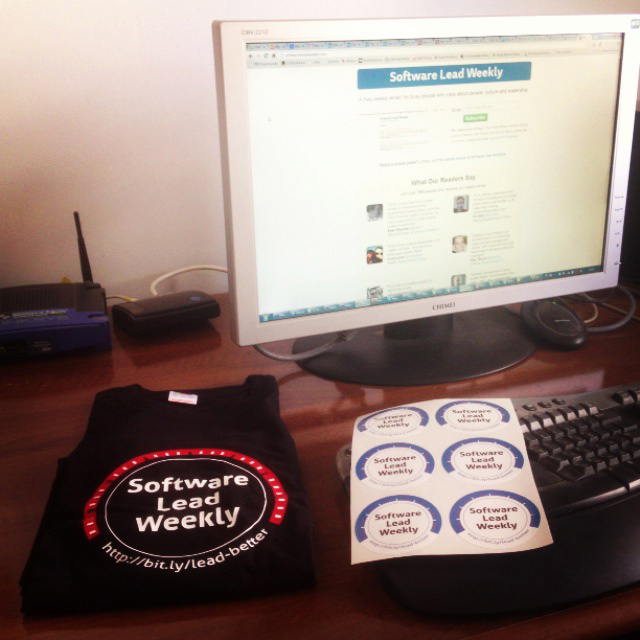
softwareleadweekly-t-shirt-klarna

It all began at Reversim Summit 2013, when Uri Nativ saw me wearing a t-shirt of SoftwareLeadWeekly:


Well, to be honest, I only printed a couple of t-shirts (no real budget) so I had none to give.

If you’d attend Uri’s talk about QA without QA, you will quickly know how unique and helpful he is. It didn’t take much time until he reached out, offering to print these t-shirts for me.

Oh, wow. Yes please!

Thanks to Uri and Michal Tirosh from Klarna Israel, SoftwareLeadWeekly got 30 t-shirts and over 200 laptop stickers to hand out. Their genuine care and passion to help was amazing – I exchanged around 30 emails with Michal, as she wanted to make sure everything will be perfect and to my satisfaction.

I felt humble and grateful to have them on my side. I still do.

Uri and Michal – Thank you!

Stop outsourcing your emotions at work

robots-optRobots: They look cool, but they don’t give a damn.

What if I would tell you that you are outsourcing one of the most powerful motivators at work, without even paying attention?

Do you remember the last time you got a gift at work for your birthday? Well, did one of your teammates actually make the effort of buying and picking it up or was it a “recommendation” passed to Human Resource department, who made it happen?

Looking back at the companies I’ve worked for, it seems that we somehow outsourced most of our ways to show our teammates we care about them. It was comfortable, so naturally, as the company grew, it became easier to outsource the “tedious work” of showing genuine interest and making the effort. A few other examples that come to mind:

  1. Welcoming new employees – do you personally introduce new employees to everyone else or do you let HR do it? Are you responsible for the workstation to be prepared or is it an “IT problem”? Do you prepare some kind of personal starter kit to WOW them on their first day at work?
  2. Life changing events (e.g. new baby, moving to a new apartment, getting a dog) –Do you let someone else send them the obvious “flowers & chocolates” combo?
  3. Holidays – are you writing a personal note to each teammate on New Year’s Eve or is there a generic gift that everyone gets?
  4. Fun days for the team – are you taking care of it by yourself or you wait for someone else to figure it all out for you?

I think we give up too quickly. We let someone else in the organization take care of our own people’s happiness.  Having a great HR department should assist and support you. They should nurture and celebrate it, but not own it completely. Their willingness to help should not make you lazy, sloppy or numb. It’s making the effort which counts most, not picking the best possible gift every time.

Why outsourcing your emotions will eventually kill your company –

When you let someone else take care of your employees, at best, you’ll create a bond between your employees and your company, as these gifts are usually company-wide and lacking real personal investment from you. When you take care of it yourself, you’ll create a bond with your people. Even better, if you involve your teammates, you will make connections between them, encouraging them to show interest in each other. In a world where people switch jobs every 2 years on average, the worst thing you can do is create the wrong kind of bond – “People leave managers (and teams), not their companies”.
 
San Antonio Spurs coach, Greg Popovich, gets it:

Yes, we’re disciplined with what we do. But that’s not enough. Relationships with people are what it’s all about. You have to make players realize you care about them. And they have to care about each other and be interested in each other. Then they start to feel a responsibility toward each other. Then they want to do for each other.


Do you also feel we have outsourced our emotions or do you see it differently? I would love to hear your thoughts, so please drop me a comment and discuss on Hacker News.

btw – are you passionate about culture and people? If so, check out my latest side-project, SoftwareLeadWeekly.

—–

Photo credit: Ѕolo.


How To Use Your Unfair Advantage To Create an Unforgettable First Day For New Hires

commerce-sciences-starter-kit

Let’s say that you’ve just hired Emma, one of the most talented [title goes here] on the face of the planet! How cool is that, right?!

If you’re like most of us, you’ve probably prepared a powerful (mac)laptop and a gigantic, cinema-size screen waiting for her arrival. But you didn’t stop there, haven’t you? You smart, devilish-fox…

You also came up with one or two tasks she can do on her first day at work, maybe even considered to let her press the BIG RED button and deploy her work to production. Anything you can do to make her feel frighteningly productive, eh? Nodding your head?

I’m sorry to burst your bubble, but you’re doing it wrong.

People want to connect with people, not with todo lists

Even though feeling productive is a strong emotion, it is also a short-lived one. In order to create a long lasting emotion, a real WOW effect, you have to create a personal bond.

Research has shown that a person’s mood can be affected even by 3 degrees of separation from people they don’t even know. That’s right, t-h-r-e-e. Do you remember feeling utterly ecstatic because a task of a user-story of a feature smiled at your direction? Nope? Nothing? Bingo!

It’s time to pull out your secret weapon.

airbnb-secret-weapn-their-team

 AirBnB’s secret weapon


Do you remember the slide of which investors drool on? The one with those smiling faces of people trying to have fun and build things? “Our Team”, you refer to it (others may call it holy-f$ck-what-a-bunch-of-geeks), and this, my friend, is your unfair advantage.

Ever wondered how you can use this handsome bunch of people to create an unforgettable first day at work for your new employees?

“Your job is to bring down the walls”

I really like the way Roy Klein, our newest secret weapon at Commerce Sciences, puts it -

You’re job at the first week is to bring down the walls and let new teammates talk and get to know the team. If they’re good, they’ll be effective anyway, so don’t worry so much about it. Find ways to make them connect. Eat lunch out every day together, play some Team Fortress 2. Whatever works!

Some ideas to get your brain ticking, your heart pumping and your face doing some funky stuff

Make them smile

To fuel your creativity, let me share a personal story. Five years ago, after getting a super talented engineer to agree joining the team at Delver, I wanted to make sure he’ll have an awesome first day.

I was so excited to have him with us that my mind was spinning like crazy, figuring out how to make it a memorable first day.

About a week before he joined, I saw on Facebook that he raved about Let’s Say You’ve Gone Back in Time poster. “Ahh!”, I thought, “I can purchase it and have it framed!” This is exactly what I did, having it hang above his workstation, waiting for his arrival.

Ask your team to be creative, to go crazy, to give away some loovvvvve

If you know that your new guy or gal enjoy playing a game, say Startcraft 2, maybe you can buy a miniature and place it on their table, with a little note “We’ve got your back! Attack!” Or, if your new hire is a part of distributed team, send them a barber shop quartet to sing her a song.

It’s time to pull some Nicki Minaj craziness to show them you were waiting for them!

Make it a company tradition

We have a little tradition, where the last person to join the company is responsible to create a “starter kit” for the next one to join. No rules, no guidelines, just your creativity, time and effort. It’s something that started before I joined, and it blew my mind on my first day at work. What a day!

8 months ago, when Omri joined the company, it was my turn to prepare something for him. Luckily, I had the chance to sit with him for lunch before his official arrival. We had an interesting discussion about our shared interests and how we’re both fascinated by “brain hacks” – figuring out how our brain works and how we could utilize it better. I remembered a great book I read called Your Brain: The Missing Manual and thought to myself that it would be a great welcome gift to give him. I knew that 5 years from now, when Omri opens this book and re-reads my dedication on the first page, he’ll remember his first day with us. It wasn’t much of a starter kit (yes, we had his working station ready as well ;)), but it was something I thought he would appreciate. I hoped it would make his first day with us memorable.

When our latest teammate, Roy, joined us, it was Omri’s turn to prepare an awesome starter kit. I forgot to mention that Omri is our marketing hero and by far the most creative dude on the team. The box you see at the top of this post was made by Omri, and was waiting on the table for Roy when he arrived. It was filled with jokes, coffee capsules, nerf-gun ammo (don’t ask) and above all, Omri’s personality.

Passionate about #culture and #people?

Check out my latest side-project, SoftwareLeadWeekly.

Your turn!

Do you have a story you can share about how you WOW-ed your new teammates? I’d love to hear from you in the comments.

Starting a Weekly Newsletter: Optimizations and Lessons Learned

softwareleadweekly-logo-340

Three months ago, I’ve started a new side-project called SoftwareLeadWeekly – a weekly email that I curate, packed with great leadership and management articles.

So far, I’ve sent 12 newsletters and collected A LOT of feedback regarding the website (where you can subscribe) and the email content my subscribers receive.

Some changes I made due to the feedback led to 24% higher click-through-rate while avoiding others helped me to see 15% higher conversion rate. Interesting eh?

Don’t try to immediately convince everyone you are trustworthy

When I’ve started with the newsletter, one of the comments I got from friends was “you need to explain your readers why they should trust you before they sign up. They don’t know you as much as we do”.

I was afraid that people wouldn’t believe me or believe that I could provide high quality content without convincing them first, so I’ve added my credibility to the top of the homepage. About a week after I launched it, I got an email from a one of my readers – “[…] got a recommendation about your site from a friend and I wanted to let you know I almost missed it. Your signup button was below the fold on my laptop and there was so much stuff going on. Just my 2c.”

Lesson Learned: I designed the page for the wrong type of visitors, aiming to convince visitors with low intent to subscribe instead of quickly allowing interested visitors to join me. I decided not to listen to my fears and let my content speak for itself. I’ve removed the section about myself, reduced the image size and moved the entire subscription-box to the middle of the page, way above the fold.

The results? 15% higher conversion rate!

Before (left) and after (right):

swl-homepage-before    swl-homepage


Poor layout can kill even the greatest content

It took me some time to learn this lesson. The quality of the content I send is critical, yet, some people still missed it because it was hard to quickly scan through my email.

I started with a poorly designed email template: gray background color, different-size images, small fonts, poor use of spacing. It was painful to read. After talking with some of my readers, I decided to simplify the layout, aiming for quick scanning – I’ve removed the gray background, got rid of the images, increased the font-size, grouped articles by topics and used proper spacing so your eyes could easily jump from one article to another. One more trick I’ve used was adding the source of the article, just like Hacker News and Reddit do, next to each link to earn credibility and provide context.

Changing my content layout increased my click-through-rate by 24%.

Lesson Learned: optimize toward clarity even before optimizing for content. Otherwise, you’re investing in something that no one will see or read. It is just like having a confusing UI with wonderful technology underneath it. No one will care.

Before (left) and after (right):

issue1          issue9

Visualize your work

When I only started, I used my email to manage my weekly list, adding great articles during the week and then organizing it on Friday, before I published my newsletter. Even though it’s a pragmatic system, I found it be boring and unmanageable. Who wants that, right?

Having some experience with Trello, I decided to give it a try, simply because Trello has such a BEAUTIFUL layout that magically makes a list of articles into a collage of thoughts. With Trello, I enjoy looking back at previous issues I’ve sent. It fuels me to keep going, to push harder, to keep it beautiful and engaging.

Lesson Learned: using visualization to manage my work makes me happier. It’s a place I can take inspiration from, looking at previous articles I’ve sent or browse through the photos. It’s like looking at beautiful painting, made of your own work. You can check out the public Software Lead Weekly Trello board.

 Software Lead Weekly Trello Board

If you found this post helpful, I’d be humbled if you’d follow me on twitter (@orenellenbogen).

Teammates First Deadlines Second

“Am I investing my full attention in my team’s deadlines at the expense of leading by example?”

Deadlines, by nature, create a powerful feedback loop, where you get rewards such as external recognition from your boss/peers and internal ones by removing a task from your To-Do list and going home feeling “productive”. Due to their visibility and ease of measurement, most managers prefer to invest their time in keeping deadlines, instead of exercising their leadership first. By entering the “deadlines loop”, it’s easy for your teammates to feel that you’re only pushing more work into the pipeline, rather than being someone they can actually follow and rely on. It’s a rhythm that is hard to break without intentionally taking steps to put your teammates first.

Even though you’ve got plenty to prove, one of the things that should be on your mind when you’re managing people is how you can engage them in a way that will make them respect you and earn their trust.

Start with setting the tone and lead by example

The idea is to gain trust by drawing on values your teammates will appreciate:

  • Get to know your people better: Treat each feature and each task as an opportunity to learn something new about your teammates. Pair Programming and Code Review are great ways to check for coding style, provide feedback and have a discussion. Make sure your teammates include these tasks when setting a deadline for a feature. Use your time together to learn which parts drive them – is it the code? architecture? new language? performance tuning? the discussion itself? the product?
  • Show them they can learn from you: Many times you’ll find yourself thinking “I could do it twice as fast” while asking for an estimation. It may be because you’ve got some expertise or (more often) you simply have a better ability to visualize the required work, thus better estimating the time it will take. Take this chance to do some pair programming: break it into tasks together (so s/he could learn from you) and my secret trick – create dependencies between the tasks, so you’ll be waiting for each other at the end (solve it by introducing interfaces and mockups so you could both work). This creates anticipation to prove to each other you can nail it. When the mockups are replaced with real code, you’ll have fun laughing if something breaks down, run mutual code-reviews and ship it together.
  • Define what “beautiful code” and “beautiful documentation” means in your team’s context: There is nothing worse than having a “religious debate” while deadlines are keeping your team working around the clock. From my experience, you should prefer using business concepts such as “beautiful code makes it easy to add new features on top of it” versus “beautiful code has 95% code-coverage” or “beautiful code has up to 5 methods per class” (here is my definition, slides 32 and 34, use it for reference but always prefer your own). Next time you sit with one of your teammates, you could say “I think the design you made for the feature is awesome *and I want it to be super easy to add more features on top of it later on. I’m not sure if we need the abstraction you suggest at this point, I prefer to see 1 or 2 more usages before we’re adding abstraction layers. I’m afraid we will build something that will make it harder to add things as we move forward, just because we’re lacking more context and real use-cases. What do you think?” 
  • Build expectations with your boss: One of the most underused tools available for you as a manager is your own boss. There is no one more passionate to see you succeed than him/her. Learn to explain why you prefer delaying a deadline and show the value you are hoping to gain – “I know that we should have completed this feature today, but I feel there is a great lesson here my teammates can learn and I want an extra day to do some retrospection and improve parts of the code. I believe it will improve their work in the long run“. Your manager, like you, has an interest in building a long-term A+ team. That means sometimes you will both need to sacrifice short-term wins. Having honest discussions with your boss, sharing your experience and asking for guidance can provide you the oxygen you need. My advice – ask your boss to tell you when s/he think you’re too focused on short-term deliveries. It will do wonders to your 1:1 sessions. 
  • Self-retrospection is not a nice-to-have anymore: I’ve written before about building a framework for improving your management skills and I highly recommend setting a 1 hour recurring meeting in your calendar once a week just for you to reflect on your work (early morning of the last day in the week should be ideal). Use it to ask yourself again “am I too focused on my deadlines or am I building confidence within my team?”


What do you think? Got more tips about setting the right balance between short-term and long-term team building? Would love to hear from you!

* always replace “but” with “and”, a great tip from Bill Gross on How to give GREAT employee feedback

———————————–
If you enjoyed this post, I’d be humbled if you’d follow me on Twitter.
photo credit: Alan Cleaver

My secret trick for Proactive Leadership

For some, the term “Proactive Leadership” means being aware of gaps, obstacles and faults before it becomes noticeable to others. The problem though, is that noticing a problem and even taking care of it, doesn’t mean you’re being perceived as proactive leader.

Let me explain – do you remember the last time your boss jumped by and said something like “you noticed that X is stuck right?” or “what are you going to do about Y?”.

“OF COURSE I DID!” you reply, “I’ve talked with Joe, and he’s taking care of it”.
This doesn’t feel like you were perceived as proactive leader right?

Proactive leadership is about being communicative when you spot these faults, as soon as they happen. So here is my secret trick – next time you see it coming, follow the “I’m on it” template:

TO: [relevant people: your boss, your peer, your teammates etc.]
Subject: Saw that [gap], I’m on it! (EOM)

For example:

To: myboss@mycompany.com
Subject: Saw that Joe left angry today, I’m on it! (EOM)

I tend to add EOM (“End of Message”) if it’s a short status update. If you feel that you’ve got more to add to this email, feel free to add to it, but never wait with the first email! It’s perfectly fine to use something like “Saw that [gap], I’m on it! More details to follow… (EOM)”.

Being communicative will reduce the need of your boss, peers and teammates to double-check everything with you. They will get custom to the ritual of “when shit happens, she’ll raise a flag”. This is how proactive leadership should be – being aware, communicative and setting the tone.

Now I pass it to you – which tricks are you using to let everyone know you’re in control?

———————————–
If you enjoyed this post, I’d be humbled if you’d follow me on Twitter.
photo credit: TORLEY

1/90 @TheJunction: The Blending of Startups

[ “ The Junction is an open house for entrepreneurs. Any active entrepreneur (regardless of his/her idea) is welcome to join, be a part of, and work at The Junction ” ]

Imagine a place where amazing developers, marketers, creative, designers and biz-dev working on their own cool startup. This is The Junction, a great place for startups to do their magic and make their dream come to life. Working here for two months made me realize that we have a huge opportunity laying under our nose – each startup is built by people with very different background but at the end of the day, our path to success looks very much the same

We all need the power of creative thinking, the right-brain of a graphic designer, the analytical mind of a developer, the wisdom of a marketer and the experience of a biz-dev. No matter what you’re working on, you need it. Why not blending our strength by helping each other out to push everyone forward?

1/90 was born - 1 day out of 90 days, which is The Junction cycle (3 months per startup).

What happened here:

1. We created a shared excel file (Google Docs) stating per startup: name, current phase, what we need most, what can we help with.

2. We met at 09:30 and did some quick lottery of the startups. Then, by number, the startup’s members explained what they need *now*, trying to be as *specific* as possible, in 3-5 minutes. People in the “audience” raised hands, if they matched the need, and we paired them together.

3. We split forces and in the next 20 minutes tried to explain each other, with some details, what exactly is needed (what is the desired outcome). At 10:15, people started to work for others, creating logos, thinking of UX/mockups, thinking of strategic marketing options and creating some working web applications. The best moment, from my perspective, was when Dany (creative @DoubleSpread) said – “it’s amazing how you take a JPG I made and transform it to a working web site in less than a day, that’s crazy!” and Effie’s (dev @Mealway) replied “no, what’s crazy is how you can create beautiful JPG in 2-3 hours from ideas I can hardly explain”. Beautiful.

4. We ended the day afternoon, where every person said what s/he did, who s/he helped, who helped her/him and how was the experience in general. The vibe was great and people really felt much more connected to each other. It was not only blending of stratups but also blending of people and friends.

I believe there is huge room for making this “event” even better in terms of productivity but I loved the fact that the team (~25 people) decided together, by themselves, how to do it and gave their heart to it. Everyone liked the idea and asked to do it at least 2-3 times per “wave” of people (so maybe it should be called 2/90 or 3/90 Winking smile).

I feel that I was part of something great, thanks to amazing group of talented, hard working and generous people. Cheers!

What we learned from our alpha so far

Our alpha version of MadLike is at the AppStore for a month now and I had the time to reflect on our learning and where we want to take our product from here. I’m writing it as it comes to my head, so the data here will be pretty raw but very authentic, based on *real* data that we gathered and *real* feedback we got along the way.

  1. Proof of Concept != Minimum Viable Product != Minimum Viable Experience – It’s very easy to mix these 3. When you’re strong in terms of execution, it’s dangerously easy to release something raw and consider it as MVP/MVE. It’s not and it’s okay, as long as you learn the things you want to learn. We sometime released something we thought will be “kinda MVP”, only to discover it’s far from it (people didn’t get it or used it as we thought). If you’re at the phase of understanding need/usage – constantly remind yourself “it’s not MVP but rather a learning step to it”.
  2. If you’re building an app for “best friends”, you better have great coverage from day one – a lot of people loved our idea and saw the need but immediately responded with “we don’t have iPhone” or “out of my best 6 friends, only 2 have iPhone”. That’s a buzz killer and it making it difficult to test user’s “clique” based on it. We’re working on a few ideas to make sure *everyone* could use our app, having iPhone or not, while acting smart about it in terms of development time and go-to-market.
  3. It’s all about the user experience – seriously, UX is not something to “keep to the end”. We’re trying to give it as much thought as we can while designing the product and thinking of the entire flow. What was changed for us? we’re now more willing to delay precious go-to-market time on making sure the experience is great. It’s not that we’re planning to sit for months without going out, it’s simply matter of releasing small things that are well thought of, instead of a mash of technical solutions/features.
  4. Money/People(equity) will not only make things go faster, it will change everything – We were willing to wait with raising money and increasing the team much longer but we came to realize that money and people open possibilities for us to release something *drastically* better to the market. Branding, creative, design – all of them are not cheap and each can entirely change the company we’re building and the experience our users will get at the end of the day.  We now understand much better our weakness and figuring out how funding and potentially joining people with equity will make our vision a sweet reality, instead of a lame “we’ll solve it one day” experience. Relying solely on our technical skills just won’t cut it.

Alright, back to do some #brogramming, have a great weekend y’all

Learning 24-7

What an insane month! We managed to achieve so much and yet it feels as if we need to move X20 faster. Every day has the weight of a month in terms of goals, pressure and the need to learn and adjust. I love it!

In less than a month, we managed to release MadLike (alpha) to AppStore (waited 10 days for Apple to approve it) and gain very helpful user base. We got a lot of feedback from people @TheJunction (where we sit), friends & family. The feedback was great and we integrated a lot of it into our future plans.


(image taken from http://www.threeriversinstitute.org/blog/)

Something *big* happened this week which I’m very proud of – we went to the mall at Herzelya (7 stars) and talked with potential users to understand what they’re doing today without MadLike. We looked for young women going out of stores with iPhone and asked them 2 main questions:

(1) “Did you happen to *avoid* buying or doing something *last week* just because your spouse or friends wasn’t there with you? ” (if “yes” – “tell me about more it”)

(2) “Let’s say you’re at the store, trying to buy something but you need your friends opinion, what do you do?”

We were amazed by the amount of people pulling out their iPhone and showing us a “question” they did via SMS or how they depicted the options over the phone. It made both of us smile and it made them super excited to see our application (we did a quick demo).
Put aside their feedback, our skills as story-teller and being accessible is crucial for our success. Every time we’re going out there to sit with people I can feel the change in myself and in my vision. Talking with people makes me more optimistic than ever about the magnitude of solution we’re bringing to the table and keeps me awake at nights, thinking how we can improve the experience for our users.

Where are we standing so far?

We’re working on the basic pain startups must validate first: activation and retention (based on Dave McClure’s startup metrics for pirates). We want to see lower % of people registered and having 0 questions. It should be easy and clear how to create questions and even more important – asking questions that happen on daily basis (shopping is hardly the case). We’re going to roll out a version this week to improve these areas. I cannot stress how happy I am to see things rolling out so quickly and how I enjoy looking at real-time data. I created some “lean” report (always open on my iPhone) to see how things going, everywhere I go. I promised myself to avoid vanity metrics at all cost so the report is holding 2 things:

1. % of people with 0 questions / total users (goal: 5% and below)
2. avg. of questions per user per week (goal: 3/user/week)

I hope that until the end of the month we’ll see these numbers reaching the goals we’re aiming for. It’s imperative for us to nail activation & retention so our entire focus is there and we’re actively collecting feedback and looking at real data. If all goes well, we’ll shift our focus toward distribution (we have some solid features planned) as part of the application usage.

Shit happens, we need to deal with it

This week our graphic designer decide to focus on her own company and told us she’s leaving. This was a real blow for us. She’s a very talented designer and great person but I could feel she’s following her dream, just like we do, so we wished her best of luck in her journey. This week we’ll need to focus on finding someone to replace her and help push things forward. We already did a few calls and I’m confident we’ll find another superstar. We cannot afford not to.

This week is going to be awesome! cannot wait to start it already…